
Search for images or info
Drawing FAQ
Drawing FAQ is a summary of all the different types of artistic questions that I have received over the last couple of years.
(FAQ = Frequently Asked Questions)
I am a hobby artist so I don't pretend to have all the answers, these are simply tips and techniques that I learned along the way.
Before emailing with a question, please check this list to see if your query has already been answered.
Popular Drawing FAQ - General
I like to draw but I don't know where to start
Welcome to allaboutdrawings.com!
Visit the Sitemap to select which page interests you the most.
Start off with copying images from your favorite topic and you will know when you are ready to progress.
I struggle with drawing, do you have a secret?
Well, it's not exactly a secret that you need to practice to improve your skills. One of my favorite sayings is 'Nothing will work unless you do.'
Since this is a common Drawing FAQ, here is a small tip to help all beginner artists...
If you are copying from a picture, you can measure the picture with your pencil (or ruler) and make tiny marks on your paper for the size of the object you are copying. Make the marks light enough that you can see them and then you can either draw over them, or erase them.
This is one way that will definitely assist you when you are learning to draw.
Read more indepth information about the measure and mark method.
I need to know more about Light and Shade
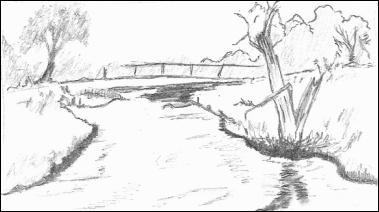
You're in luck! There's a whole page devoted to learning about light and shade.
How do I keep my drawing clean?
One way to prevent smudging is to place a spare sheet of paper under your hand as you draw. This also stops the oil from your skin getting onto the surface.
Categories
Sketches
Instruction
Freebies
Other Areas

 Follow me


** Disclaimer: I receive a small commission if you buy via my links -- at no extra cost to you. **
The How To Sketch Guide
Here's a book that finally dispels the mystery of sketching!
... it only takes a little instruction
or guidance... Read more >>
Now In Paperback!
My first eBook
My 4th eBook

My 2nd eBook
My 3rd eBook
Who are the Masters?
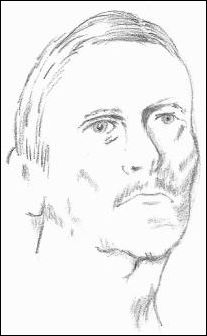
Copying an old master gives you the opportunity to study what they did to create the effect of a finished piece.
Masters of drawing in the 1400's and 1500's included Leonardo da Vinci, Albrecht Durer, Michelangelo, and Raphael.
During the 1600's, Claude, Nicolas Poussin, Rembrandt, and Peter Paul Rubens created important artwork.
In the 1700's, great images were produced by Jean-Honore Fragonard, Francisco Goya, Giovanni Battista Tiepolo, and Antoine Watteau.
The Masters during the 1800's included Paul Cezanne, Jacques Louis David, Edgar Degas, Theodore Gericault, Jean Ingres, Odilon Redon, Henri de Toulouse-Lautrec, and Vincent Van Gogh.
Great works in the 1900's have been created by Max Beckmann, Willem De Kooning, Jean Dubuffet, Arshile Gorky, Paul Klee, Oscar Kokoschka, Henri Matisse, Jules Pascin, Pablo Picasso, and Jackson Pollock.
Thanks Wikipedia for providing this information for our Drawing FAQ.
Drawing FAQ Tips
Can you give me more tips?
I share all of my favorite drawing tips, pop over there and take your pick.
What materials do I need to learn?
Here's a guide for the very few drawing supplies that you need to get started.
I have a set of pencils but I don't know which one is light or dark.
Experiment!
A 'H' is light and a 'B' is dark.
H grade stands for 'Hard' and they are good for shading. You can't press on hard pencils or you will ruin your paper. Higher numbers on H pencils means the graphite gets harder and lighter. Personally, I don't use my H pencils very much.
B stands for 'Black'. A 2B is a very user friendly pencil when you are learning to draw. It can give light or dark strokes, depending on the amount of pressure you use. Higher numbers on B pencils means the graphite gets softer and darker.
HB is in between a 'H' and a 'B'.
I have to look at something before I can draw it. Can you help me draw from my imagination?
Most artists observe then draw - it's natural! It takes time before we become proficient enough to create a good image from our imagination so be patient with yourself.
There are various ways you can train your brain, try using the hints from my page about drawing from memory.
Here's another trick to help you draw from memory.
How Should I Hold My Pencil?
You can hold your pencil the same way as your pen - between the thumb and the first two fingers (generally). This way, your hand won't tire because of the perfect balance you are able to achieve with this comfortable grip.
For light, feathery lines try holding the pencil lightly and half-way up the shaft. This grip is great for sketching.
For rich firm effects hold the pencil firmly and lower on the shaft, rubbing the lead to and fro without removing the point from the paper.
For small or detailed illustrations, you might like to hold the pencil lower still.
Hold the pencil in a way that suits you.
Some art tutors will advise you to hold the pencil between the 2nd and 3rd fingers. Don't you think it would be wiser to be comfortable while you wrestle with new drawing techniques?
How do I spot a flaw in my artwork?
There are a couple of ways you can do a little test, to see where you are going wrong.
- Turn it upside down which gives you a new angle and perspective to view.
- Look at it in the mirror where errors will easily stand out.
- Use reference material that is already black and white, this helps you to see the proper values.
- Wait one day to view the drawing from a completely new point of view. This is my favorite go-to for finding mistakes.
I can't draw a straight line. Any advice?
If you sign up for the free newsletter, you learn all sorts of things. Find the tip to overcome this problem in the October 2007 back issue.
You can also turn your paper -- it's easier to draw a horizontal line than it is to draw a vertical line.
I can't draw animals, can you help?
You could try tracing the outline of the animal to help you understand the form a bit better. Tracing is one of the 'tools' used for learning purposes.
Also, converting the main form of the animal into shapes is a common favorite for lots of artists.
Drawing FAQ - Your Gallery
How do I send my drawings in?
Unfortunately, this option is not available at this time so we use the All About Drawings Facebook page instead.
Drawing FAQ - What Is ...?
What is a gesture drawing?It's the term used to describe the quick strokes of a pencil to capture movement. You won't see much detail because they are done rapidly. What is shading?
Add depth to your illustrations by adding darkness to a surface, opposite the light source. What is overlapping?
When an object is drawn in front of another object (partially concealing a piece of the back object) to make it appear closer. What is a tonal drawing?
- Shows gradual blending of light and dark areas together. I think all of these terms are only created to cause confusion, it's similar to the meaning of value. What is value drawing?
- Shows the light and shadow and surface tones, and it creates a three-dimensional illusion. Value is a fancy word for shading - the darkness or lightness of a color. What is a line drawing?
A black and white image that is constructed solely by using lines, without details or shading.
It is usually an outline of an object or form. It's also referred to as Linear or Line Art. What is an ellipse?
A curved figure like a circle, but it has one diameter greater than the other. It's as if a circle has been stretched sideways.
An Oval is a kind of ellipse, with one end narrower than the other. A circle viewed sideways appears as an ellipse. What is diffused light?
The light of an ordinary room or the (absence of) light noticed on a cloudy day. What is perspective?
To demonstrate how an object appears as seen by the eye. Objects appear smaller according to distance. What is foreshortening?
Lines used to create the illusion of depth, to illustrate that something is actually closer to your eye.
I would say it's a relative of perspective.
For example, if you draw someone pointing a finger at you, the finger and hand are foreshortened which means they appear larger than the arm or head. What is chiaroscuro?
An art term that describes the contrast between light and shade.
Drawing FAQ About This Website
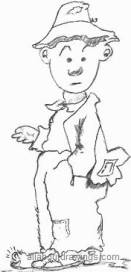
What is the aim of this website?
I started this website to encourage everyone to begin teaching themselves to draw.
I have always been interested in learning to draw but just didn't think I had any talent.
Imagine my delight when I first started by copying existing artwork and others could recognize what I drew? It makes you feel powerful!
Unfortunately for me, I'm in the later half of my life and I don''t want that for you. I want you to discover this hobby now and to experience the richness it brings to your life.
This is a perfect time for you to join me and we can learn to draw together.
How did you build this website? Do you earn money?
Here's how I found out how to build a website.
I earn a commission when products are purchased via any direct link on this site. Here is a list of the drawing books that I have bought myself so I can make sure they are good before I recommend them.
When was this site established?
I started building this site in 2005 and it's not finished yet!
I am writing to ask permission to use your images for a school project.
You are most welcome to use any of my artwork for your school projects. Students (who previously asked permission) give credit in their projects to www.allaboutdrawings.com as their image source, which I appreciate.
Drawing FAQ
Well folks, that's it! Those are the Drawing FAQ (frequently asked questions) that I have received so far.
I hope you have found the answers to be helpful. I have a profound love for drawing and all I want to do is pass it on to you.
It really is easy, if you want to draw, you can. Just try it by copying simple little images and you'll be amazed by your own efforts.
There's more for you to enjoy...
* Allaboutdrawings.com is a participant in the Amazon Services LLC Associates Program, an affiliate advertising program designed to provide a means for sites to earn advertising fees by advertising and linking to Amazon.com.
Copyright © 2005 - 2024 www.allaboutdrawings.com. All rights reserved.