
Search for images or info
Perspective Drawing
Perspective drawing can bring on the shudders for many trainee artists, including me.
Perspective has to do with the shape and size of objects.
- It can alter shape according to viewpoint.
- Size is also affected depending on the distance from the spectator.
Take heart though, you don't need to become overwhelmed by this advanced technique because there are lots of things you can draw where perspective doesn't come into play.
For instance, when you concentrate on subjects nearest to you, perspective is eliminated.
A full front view, or a full side view, has no vanishing point because you are too near. In reality, there is nothing that recedes from you.
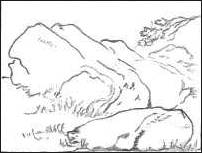
Apprentice artists need to focus mainly on subjects with a close viewpoint so that learning to draw is mastered first. There is plenty of time to learn perspective drawing later on.
So, when you are ready and you want to know more, here are some good, basic guidelines that set you on the path to understanding how to portray size and distance.
Study the diagrams below so that bit by bit, you come to understand drawing in perspective.
Understanding Perspective
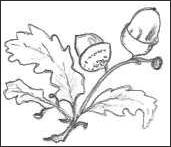
When you look out upon a landscape in nature, you can clearly see the stones, grass and leaves that are close to you, along with any imperfections they may have.
When you look further ahead, say a few hundred feet, you can still see grass and leaves, but it is a mass of green and stones become blurred with their overall color.
Look ahead even further, way into the distance, and you see nothing plainly. Even mountains look a grey or bluish color which is not how they appear nearby. These subtle changes are what is referred to as perspective.
Now when you want to represent on paper all the parts of the view we have been talking about, you must do it as it appears in nature by making the objects smaller and dimmer as they are more distant.
As a learner drawer, this advice is really good news! That means you only need to represent things in the distance as a scribbled and vague shape so you can't ask for anything easier than that. Always look on the bright side, I say.
There are two kinds of perspective:
Aerial:
Aerial perspective is the dimming of objects as they go farther from the eye. This is because there is a greater depth of air to look through.
When you look at the sky, you see nothing but blue and this blue sky is the air.
If you watch a plane as it flies further away from you, it kind of blends in with the blue of the sky and then it disappears which leaves nothing but air to look at.
Linear:
Linear perspective is represented by lines. These lines, if drawn from the top and bottom of an object, seem to run to one point, far in the distance.
This is termed one-point perspective drawing, where all objects vanish towards one common point.
Categories
Sketches
Instruction
Freebies
Other Areas

 Follow me


** Disclaimer: I receive a small commission if you buy via my links -- at no extra cost to you. **
The How To Sketch Guide
Here's a book that finally dispels the mystery of sketching!
... it only takes a little instruction
or guidance... Read more >>
Now In Paperback!
Simple Drawing Tips
4 kindle books combined
into one tidy book.

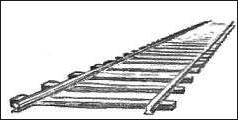
You can see this when you stand in the middle of a railroad track. The lines of the rails seem to run nearer together as they go away from you.
The Vanishing Point
If you watch a hot air balloon go up, you first notice how large it is when close to you. As it goes higher and farther, it gets smaller and smaller. If you continued to watch it sail through the sky, it becomes a mere speck and out of sight. This point, where the balloon goes out of sight, is called the vanishing point.
The true horizon line is the point where the land and sky meet, and is always on a level with the eye. So that means the horizon line and the vanishing point are always on a level with the eye of the person who looks at the view, as shown below.
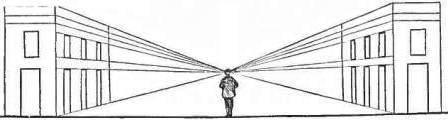
A central line is drawn to portray the horizon and you see that all the lines run to the dot at the man's head. This dot is the vanishing point, and if the houses were built right up to this point, that makes it a pretty long street, and the house at this point would be out of sight. In the example above, the artist has used only one-point perspective.
I began to understand perspective once I grasped the mechanics of the vanishing point so I hope it helps you, too.
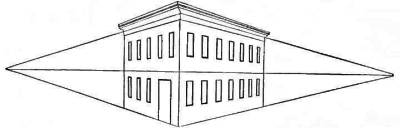
In this diagram above, the building is viewed with the corner closest to you. Therefore, there are 2 walls in your vision and each wall recedes into the distance. Clearly, they recede in different directions so you need two vanishing points, one for each side, marked on the horizon line. This is called two-point perspective drawing.
There can be numerous vanishing points in a drawing.
An Exercise In Perspective Drawing
Let's suppose there are two large, square blocks, both the same size. One is further away and looks smaller.
In the diagram below, A is the base line, B the horizon line and C the vanishing point.
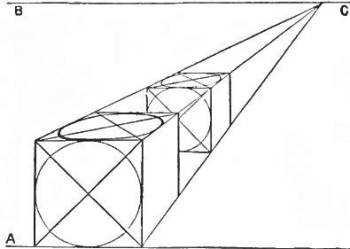
On the front and top of each block is a circle which represents a wheel. The front wheel is round, the top wheel is actually oval but it looks round because it is drawn in perspective.
Copy this diagram to further understand the basics and do it in this order:
- First draw the square front of the first block, with the diagonal (crossed) lines, any size you like,
- do the circle next,
- then the base line (A),
- and horizon (B) last.
- For the vanishing point (C), you fix a point anywhere you please on the horizon line.
- Now draw lines from 3 corners of the first block, (omitting bottom left, next to "A") to join up with the vanishing point.
- Refer to the diagram and put another line further along for the second box, make the cross from each top corner and put in the wheels, front and top. Take a look, you now have the block and wheel in perspective!
Did you happen to notice that all the vertical lines remain vertical? Vertical lines are always vertical unless you draw a high rise building with the viewpoint from the ground upwards, in which case they recede and vanish exactly as we have discussed previously.
Practice drawing the above diagram to get the principle well fixed in your mind.
The Horizon
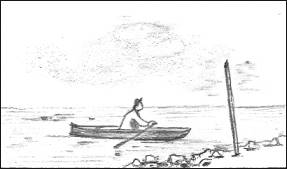
All lines will meet at the height of your eye, or at the horizon.
If you sit in a boat on the ocean, the horizon line will be on a level with the eye, like in this drawing:
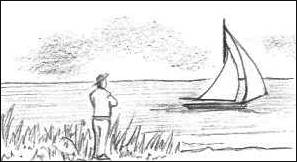
If you stand on the level shore, the water line will rise to the eye and the strip of water is as wide as you are high, as in the illustration below:
Recently, I was on the balcony of a high rise building at the coast so I did my own observation of checking that the horizon was at eye level no matter whether I was standing or sitting. It was quite a revelation, I have never had reason to notice that before!
All in all, these are the general principles of perspective.
You will find more complex examples in advanced books, but there is enough here to guide you in drawing simple objects.
If you study these rules for perspective drawing and try to understand them, it will help when you're ready to go the extra mile in your illustrations.
I find it helps to avoid things that I don't understand straight away and I concentrate on what I am capable of doing at the time. Somehow everything evolves at its own pace. I urge you to protect your enthusiasm and keep drawing whatever it is that makes you happy -- this allows stuff to just happen on its own accord.
Quick Search
Use the search box to find something -- just type in your favorite topic...
Click a link below to view some different pencil techniques:
There's more for you to enjoy...
* Allaboutdrawings.com is a participant in the Amazon Services LLC Associates Program, an affiliate advertising program designed to provide a means for sites to earn advertising fees by advertising and linking to Amazon.com.
Copyright © 2005 - 2024 www.allaboutdrawings.com. All rights reserved.