
Search for images or info
Rhythm Drawing
Have you ever heard of rhythm drawing?
When you learn to draw, it's a very good idea to establish a rhythm of sorts, to feel the flow of the pencil beneath your fingers.
If your illustrations are stiff and tentative, you can remove that awkwardness by practicing the rhythm drawing exercises below.
I know the feeling of incompetence that any new artist feels when faced with a blank sheet of paper. You might ask 'How do I start?' or 'Where do I start?'
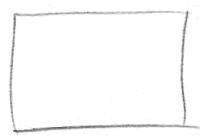
The first and easiest step is to roughly draw a border on your paper... See, now you're off to a flying start, you've made some marks and that's the hardest part!
Use the edges of the paper as a guide for getting your border fairly straight but there's no need to be paranoid about it as you can see in my example.
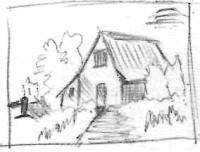
It doesn't matter if you are copying a picture or copying nature, look for the main lines in your chosen subject and make some quick, light strokes on your paper.
Do this with surety and confidence even if you don't feel those sensations.
This sketch was done in seconds, very roughly, but you can already see what I want to portray. In reality this image is barely visible but I made it darker for viewing purposes.
You want to firmly establish the habit of drawing with rhythm so remember with every beginning there is always some uncertainty.
Your first aim is to make a fair start and produce good effects.
- Let your pencil move backward and forward with quick movements.
- You'll notice you create line after line.
Make sure these initial lines are very light and once you're sure they are correct you can go over them with more confidence later.
About Rapid Drawing
You may have heard other artists speak about rhythm drawing or they could also have referred to it as rapid drawing. The two go hand in hand because they mean that you need to draw quickly to find a rhythm.
There is no doubt that this type of artwork contains energy.
The sketches below are rough and imperfect so you won't be afraid to try them. Pretty soon you will find that you can do much better!
Enjoy your practice session as you follow the blue printed directions below the image.
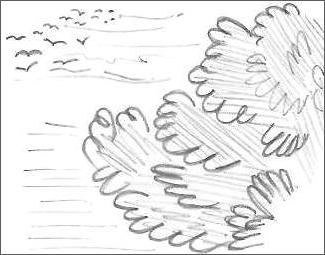
Do an air drawing with your finger, following the movement of line.
Now copy it on paper.
Copy again and complete within 2 minutes.
Have a go at reproducing it from memory.
Categories
Sketches
Instruction
Freebies
Other Areas

 Follow me


** Disclaimer: I receive a small commission if you buy via my links -- at no extra cost to you. **
The How To Sketch Guide
Here's a book that finally dispels the mystery of sketching!

... it only takes a little instruction
or guidance... Read more >>
Of course, there is no need to replicate this drawing exactly, you only need to feel the movement and portray it along similar lines.
Once you establish a rhythm, everything goes ahead very easily and quickly.
Follow the directions below to complete the next exercise.
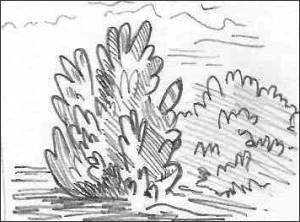
Do an air drawing with your finger, following the movement of line.
Copy and complete it within 3 minutes.
Copy again only this time complete it within 2 minutes.
Reproduce it as best as you can from memory.
With free and regular movement of the hand, you will quickly progress.
Once your hand and eye have increased their skill, your touch becomes more certain and objects will emerge without much trouble. You feel more confident and brave enough to create an original sketch - isn't that what you always want to do?
Just be patient and if you practice rhythm drawing consistently, your reward is just around the corner!
Using Dots As Markers
Sometimes it helps to use dots as a guide to complete the outline of a subject, depending on how complex it is.
Here is a little exercise that shows how to follow dots with rhythm and contour.
On your paper, place random dots at different distances apart. The idea is to make an easy flowing curved line from the first dot to the last, avoiding breaks and angles.
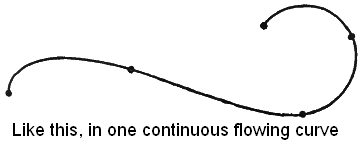
Important: Don't watch the pencil-point. Envisage a curved line (that is already on the paper) going through those dots.
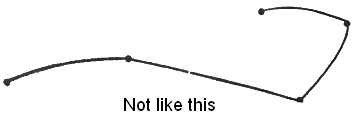
Accurate artwork involves mental picturing. If you have difficulty doing this, the above exercise should help you to develop that skill.
Drawing With Rhythm
I can't stress enough that you won't improve without practice. All it takes is for you to find an exercise that interests you so you can continuously draw to improve. You can do this!
The rapid drawing exercise will not only show you a way of implementing speed into your work but it's also a great way to exercise your memory.
You will have your own select audience who likes your artwork and they want to witness how you view the world so just draw what you see and like.
If you fall into the habit of rhythm drawing, your images will evolve on paper so naturally that I'm sure it will surprise you. Well, I know that's what happened to me after I practiced with everything I share here.
Take care, have fun and enjoy!
Click a link below to view a good variety of pencil tips:
* Allaboutdrawings.com is a participant in the Amazon Services LLC Associates Program, an affiliate advertising program designed to provide a means for sites to earn advertising fees by advertising and linking to Amazon.com.
Copyright © 2005 - 2024 www.allaboutdrawings.com. All rights reserved.