
Search for images or info
Upside Down Drawing
Upside down drawing is a fascinating study of learning to see the way an artist sees, while not actually identifying what you are depicting or seeing.
When I was learning to draw, one of the things I enjoyed the most was the different methods available for trainee artists. Nothing gave me more of a thrill than to finish up with a good reproduction when (in my heart) I thought I couldn't draw.
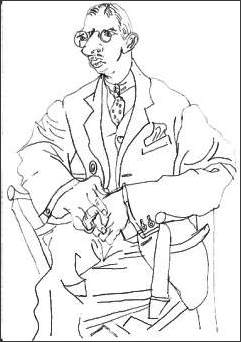
In the Betty Edwards art book, Drawing on the Right Side of the Brain, Betty provides an upside down Pablo Picasso sketch of the 'Portrait of Igor Stravinsky.'
The image on the right is my first attempt at copying that sketch upside down. Of course, I have turned it right side up for viewing.
It's not correct in proportion but, I can tell you, I was over the moon with the outcome of this exercise! Remember, at that time, I thought I'd never be able to draw properly.
Author Betty wisely chose the Picasso drawing because all the lines join together and they form a type of jigsaw puzzle.
It was the first upside down drawing that I ever did and not only did I enjoy it, but the encouragement I derived from this exercise ultimately introduced this artistic hobby into my life.
Before You Start
It really helps to place a border on your paper with the same measurements as the picture so do this one step before you begin.
When you start copying, focus only on lines and their direction or angle. It's your choice where you start so choose top or bottom whichever is your preference.
Keep your mind purposely blank and refuse to try to identify what you are portraying.
When you concentrate on the distance of the lines to the border and their relation to each other, the image develops by itself. It's remarkable, really.
Negative space automatically plays a part because of the squares and rectangles that are present in the picture and you can choose to draw that shape rather than the lines of the subject.
Negative space is the area around the object that you are interested in depicting.
I didn't do that, I thought it was easier to just focus on the line with no other distractions.
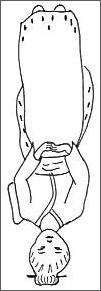
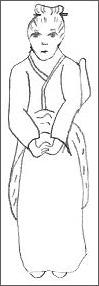
The Geisha Girl drawing is one that I have practiced with - I always look for images with simple lines so I can turn it upside down and see what I produce.
When I finished this upside down drawing, I turned my paper the right way up. Ok, my interpretation isn't great but it resembles the original sketch! It is still exciting!
At a time when I seriously doubted I'd ever be able to draw, the upside down drawing experiment was the starting point of my artistic adventure. Why? Well, it gave me the confidence that I needed to keep going and experimenting.
If I happened to produce a failure, I wasn't deterred by that because I knew I could draw -- I had already proven it with the Pablo Picasso experiment above! You can do this too, try it for yourself.
What is the purpose of Upside Down Drawing?
The purpose of this kind of practice is to force your left (thinking) side of the brain to give up identifying what you draw.
So, even if you have a little voice that tells you the name of features or things, - ignore it! Instead, focus on a specific line and concentrate on its direction and where it lies in relation to the lines around it.
I do have trouble with matching things up as I come to the end of the drawing because it is obviously out of proportion. That doesn't matter, just connect it all as best as you can because the benefit remains.
Categories
Sketches
Instruction
Freebies
Other Areas

 Follow me


** Disclaimer: I receive a small commission if you buy via my links -- at no extra cost to you. **
The How To Sketch Guide
Here's a book that finally dispels the mystery of sketching!
... it only takes a little instruction
or guidance... Read more >>

Simple Drawing Tips
4 kindle books combined
into one tidy book.
What is the Biggest Benefit of This Exercise?
Simple - it helps to set you on the path of seeing the way an artist sees! That, in turn, helps you properly illustrate whatever you want.
Upside down drawing develops your ability to see only lines and shapes and their relation to each other which is the ultimate aim for all artists.
You are not meant to recognize anything. Avoid naming objects and your drawing skills will improve.
Drawing Exercise
There are many ways to master the art of drawing. We can trace, use a grid or we can copy images from art books, to name just a few.
Drawing upside down is a favorite method of mine because it trains your eyes to really see. You examine the length of a line, the curve in a line and distances from other lines -- it's an excellent practice to perform.
You can do this with any simple image that is comprised of lines or contours. There are a couple of line drawings on this page if you would like to copy one right now.
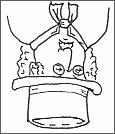
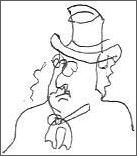
For an experiment, I combined blind contour with upside down drawing using the reference image on the left.
The drawing on the right is the result of upside down and not looking..
That dual exercise really made my mind go blank, I had no idea what I was producing but I don't think it's too bad. Actually, I think it kind of looks like a quick gesture drawing!
When you draw upside down, try to take notice of how your mind 'turns off'. Your academic brain doesn't recognize what it is you are portraying, so it hands the job over to the artistic side of your brain. Ahh, pure peace reigns. You will most likely notice the calmness that takes over your entire being and that means you are using the artistic (right) side of your brain.
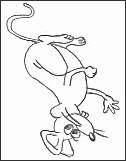
Tip: If you feel confused by a large picture, try placing paper over the picture and just reveal one portion at a time. You'll only need to do this once or twice. When your confidence builds, you won't even notice the whole picture, you will only be seeing the lines you are copying.
Copy the picture just as you see it and don't be tempted to turn it the right side up at any time. You can start anywhere on your page that you feel comfortable with.
It's fine if you wish to erase. Sometimes our judgment is a little bit out - I know my hand has a mind of its own and sometimes lines appear that I don't even agree with!
Practice upside down drawing by copying images from any art books that you have and, most of all, have fun doing it!
Click a link below to view a good variety of pencil tips:
* Allaboutdrawings.com is a participant in the Amazon Services LLC Associates Program, an affiliate advertising program designed to provide a means for sites to earn advertising fees by advertising and linking to Amazon.com.
Copyright © 2005 - 2025 www.allaboutdrawings.com. All rights reserved.